


Automatic differentiation#
Refs:
https://alexey.radul.name/ideas/2013/introduction-to-automatic-differentiation/
http://autodiff.org/
https://www.kaggle.com/code/borisettinger/gentle-introduction-to-automatic-differentiation
https://en.wikipedia.org/wiki/Automatic_differentiation?useskin=vector
https://towardsdatascience.com/pytorch-autograd-understanding-the-heart-of-pytorchs-magic-2686cd94ec95
https://d2l.ai/chapter_preliminaries/autograd.html
https://arxiv.org/abs/1502.05767
https://www.youtube.com/watch?v=wG_nF1awSSY&t=0s
https://www.youtube.com/watch?v=ZGSUrfJcXmA
https://www.youtube.com/watch?v=YQ7RIHMWA88
How to differentiate in the computer?
Exact: Not always available. Imagine a neural network with millions of parameters, you cannot just do it manually.
Symbolic (sympy, mathematica, …): Expression tree explossion (see, for instance, the multiplication rule). Derivative of data struct?
Finite differences: Stability and precision. O(n) evaluations for n-dimensional gradient.

Applications of Automatic Differentiation#
Optimization (multi-dimensional) based on gradient computations (neural networks)
Sensitivity analysis (\(\partial(result)/\partial(input)\))
Physical modeling (computing forces as derivatives of potentials, computing equations of motion from Lagrange or Hamiltonian equations)
Probabilistic inference (Hamiltonian Monte Carlo)
Machine learning
…
Forward-mode (directional derivatives): Dual numbers#
Based in infinitesimal calculus: \(\epsilon^2 = 0\). So a Taylor expression for an approximation is
The pair \((x, f'(x))\) is called a dual pair. And there are operating rules such us
By extending the basic operations to this dual numbers, we can compute the derivative automatically by evaluating the epsilon coefficient of \(dual-version(f(x+epsilon 1))\)
The following is a simple implementation (https://www.kaggle.com/code/borisettinger/gentle-introduction-to-automatic-differentiation)
class DualBasic(object):
    def __init__(self, val, eps):
        self.val = val
        self.eps = eps
Python magics for some basic ops
class DualBasicEnhanced(object):
    def __init__(self, *args):
        if len(args) == 2:
            value, eps = args
        elif len(args) == 1:
            if isinstance(args[0], (float, int)):
                value, eps = args[0], 0
            else:
                value, eps = args[0].value, args[0].eps
        self.value = value
        self.eps = eps

    def __abs__(self):
        return abs(self.value)

    def __str__(self):
        return "Dual({}, {})".format(self.value, self.eps)

    def __repr__(self):
        return str(self)
class DualArith(object):
    def __add__(self, other):
        other = Dual(other)
        return Dual(self.value + other.value, self.eps + other.eps)

    def __sub__(self, other):
        other = Dual(other)
        return Dual(self.value - other.value, self.eps - other.eps)

    def __mul__(self, other):
        other = Dual(other)
        return Dual(self.value * other.value, self.eps * other.value + self.value * other.eps)
And also include division: $\( \frac{1}{x+ae} = \frac{1}{x} - \epsilon \frac{a}{x^2}, \)$ so
class DualDiv(object):
        def __truediv__(self, other):
            other = Dual(other)
            if abs(other.value) == 0:
                raise ZeroDivisionError
            else:
                return Dual(self.value / other.value,
                            self.eps / other.value - self.value / (other.value)**2 * other.eps)
Now this is the dual class
class Dual(DualBasicEnhanced, DualArith, DualDiv):
    pass
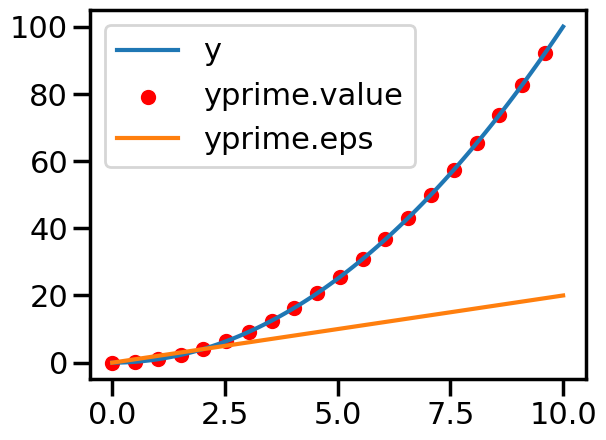
This is now an example for the automatic derivative of \(x^2\)
def square(x):
    return x*x
If we want to compute the derivative at \(x=3\), we use
square(Dual(3.1,1))
Dual(9.610000000000001, 6.2)
As you can see, in the primal part we have \(3^2 = 9\), and on the dual part we have the derivative evaluated at \(x=3\).
Now let’s use another function,
def cube(x):
    return x*x*x
cube(Dual(2,1))
Dual(8, 12)
Let’s plot
import matplotlib.pyplot as plt
import seaborn as sns
import numpy as np
sns.set_context("poster")
# Data
x = np.linspace(0.0, 10.0, 100)
y = square(x)
yprime = square(Dual(x, 1))

# Plot
sns.lineplot(x=x, y=y, label="y")
sns.scatterplot(x=x[::5], y=yprime.value[::5], marker="o", label="yprime.value", color="red")
sns.lineplot(x=x, y=yprime.eps, label="yprime.eps")
<Axes: >
What about the error?
print(np.abs(1-yprime.eps/(2*x)))
sns.lineplot(x=x, y=np.abs(1-yprime.eps/(2*x)))
[nan  0.  0.  0.  0.  0.  0.  0.  0.  0.  0.  0.  0.  0.  0.  0.  0.  0.
  0.  0.  0.  0.  0.  0.  0.  0.  0.  0.  0.  0.  0.  0.  0.  0.  0.  0.
  0.  0.  0.  0.  0.  0.  0.  0.  0.  0.  0.  0.  0.  0.  0.  0.  0.  0.
  0.  0.  0.  0.  0.  0.  0.  0.  0.  0.  0.  0.  0.  0.  0.  0.  0.  0.
  0.  0.  0.  0.  0.  0.  0.  0.  0.  0.  0.  0.  0.  0.  0.  0.  0.  0.
  0.  0.  0.  0.  0.  0.  0.  0.  0.  0.]
/tmp/ipykernel_2293/4071155334.py:1: RuntimeWarning: invalid value encountered in divide
  print(np.abs(1-yprime.eps/(2*x)))
/tmp/ipykernel_2293/4071155334.py:2: RuntimeWarning: invalid value encountered in divide
  sns.lineplot(x=x, y=np.abs(1-yprime.eps/(2*x)))
<Axes: >
More general implementation#
What about other functions?
def myexp(x):
    return np.exp(x)
myexp(Dual(3,1))
---------------------------------------------------------------------------
AttributeError                            Traceback (most recent call last)
AttributeError: 'Dual' object has no attribute 'exp'

The above exception was the direct cause of the following exception:

TypeError                                 Traceback (most recent call last)
Cell In[11], line 3
      1 def myexp(x):
      2     return np.exp(x)
----> 3 myexp(Dual(3,1))

Cell In[11], line 2, in myexp(x)
      1 def myexp(x):
----> 2     return np.exp(x)

TypeError: loop of ufunc does not support argument 0 of type Dual which has no callable exp method
We need to use specialized libraries that have already and correctly implemented automatic differentiation, like
pytorch autograd: https://pytorch.org/tutorials/beginner/blitz/autograd_tutorial.html
Tensorflow autodiff: https://www.tensorflow.org/guide/autodiff
numpy autograd: https://github.com/HIPS/autograd
…
Using pytorch#
https://pytorch.org/tutorials/intermediate/forward_ad_usage.html
https://towardsdatascience.com/getting-started-with-pytorch-part-1-understanding-how-automatic-differentiation-works-5008282073ec
!pip install torch
#!conda install pytorch
# Example from https://sebarnold.net/tutorials/beginner/blitz/autograd_tutorial.html
import torch
from torch.autograd import Variable
x = Variable(torch.ones(2, 2), requires_grad=True)
print(x)
y = x + 2
print(y)
print(y.grad_fn)
z = y * y * 3
out = z.mean()

print(z, out)
out.backward()
print(x.grad)
Original example#
import torch
import matplotlib.pyplot as plt
import seaborn as sns
sns.set_context('poster')

x = torch.linspace(0.0, 1.0, 100, requires_grad=True)
y = torch.exp(2*x)
# Compute the gradient using torch.autograd.grad
grads = torch.autograd.grad(y, x, torch.ones_like(y), create_graph=True)[0]
# Convert torch tensors to NumPy arrays for plotting
x_values = x.detach().numpy()
y_values = y.detach().numpy()
dy_dx_values = grads.detach().numpy()

# Plot y and dy_dx
sns.lineplot(x=x_values, y = y_values, label=rf'$\exp(2x)$')
sns.lineplot(x=x_values, y = dy_dx_values, label=rf'$dy/dx$')
Using tensorflow#
https://www.tensorflow.org/guide/autodiff
!pip3 install tensorflow
#!conda install tensorflow
import numpy as np
import matplotlib.pyplot as plt

import tensorflow as tf
x = tf.Variable(3.0)
print(x)
with tf.GradientTape() as tape:
    y = x**2
# dy = 2x * dx
dy_dx = tape.gradient(y, x)
dy_dx.numpy()
import tensorflow as tf
x = tf.linspace(0.0, 10.0, 100)
with tf.GradientTape() as tape:
    tape.watch(x)  # You need to watch the variable x explicitly.
    y = x**2
#print(y)
dy_dx = tape.gradient(y, x)
print(dy_dx)
# Convert TensorFlow tensors to NumPy arrays for plotting
x_values = x.numpy()
y_values = y.numpy()
dy_dx_values = dy_dx.numpy()

import seaborn as sns
sns.set_context('poster')

# Plot y and dy_dx
sns.lineplot(x=x_values, y=y_values, label=rf'$y = x^2$')
sns.lineplot(x=x_values, y=dy_dx_values, label=rf'$dy/dx$')
Exponential#
import tensorflow as tf
x = tf.linspace(0.0, 1.23, 100)
with tf.GradientTape() as tape:
    tape.watch(x)  # You need to watch the variable x explicitly.
    y = tf.exp(2*x)
#print(y)
dy_dx = tape.gradient(y, x)
print(dy_dx)
# Convert TensorFlow tensors to NumPy arrays for plotting
x_values = x.numpy()
y_values = y.numpy()
dy_dx_values = dy_dx.numpy()

import seaborn as sns
sns.set_context('poster')

# Plot y and dy_dx
sns.lineplot(x=x_values, y=y_values, label=rf'$y = exp(2x)$')
sns.lineplot(x=x_values, y=dy_dx_values, label=rf'$dy/dx$')
Implementation using autograd#
https://github.com/HIPS/autograd You will do it